
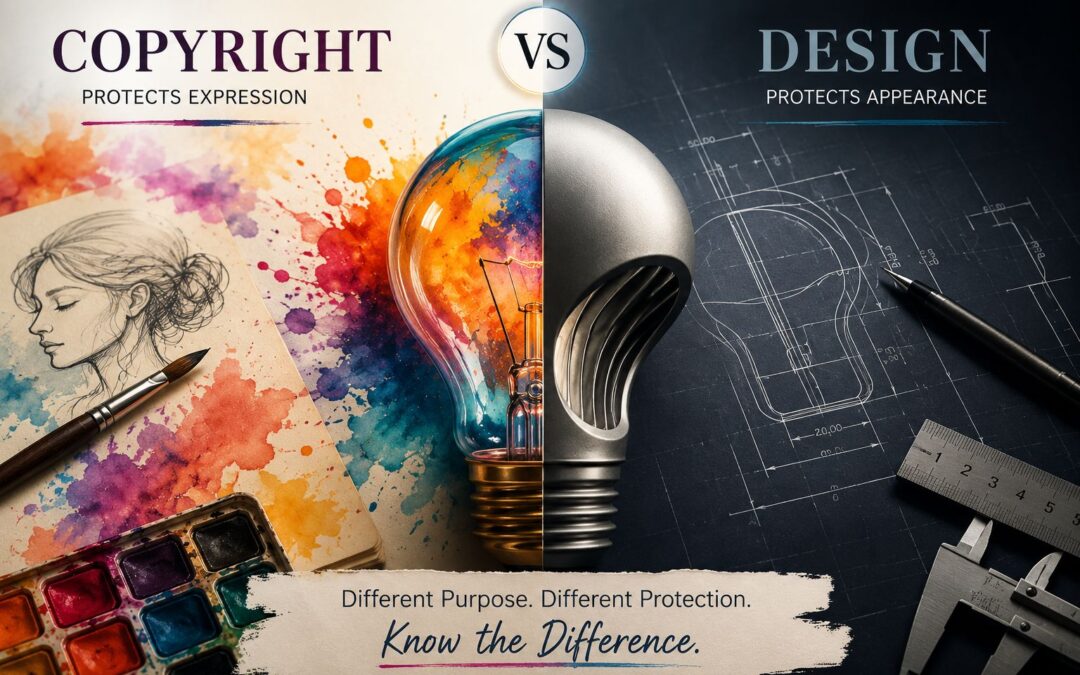
An original artistic work does not always remain confined to paper or a digital screen. A sketch may evolve into the design of a chair, a pattern may be reproduced on garments, or an illustration may become part of product packaging manufactured on a commercial scale. As creative works move from artistic expression to commercial application, an important legal question arises: does copyright continue to provide adequate protection, or does design law become the more appropriate regime?
Indian law addresses this distinction through the Copyright Act, 1957 and the Designs Act, 2000. While both statutes protect intellectual creations, they serve different purposes. Understanding where copyright protection ends and design protection begins is essential for creators, designers, manufacturers and product developers seeking to protect their valuable creations.
Copyright Protection
Many products begin as original artistic works. A textile pattern, jewellery sketch, wallpaper design or artwork for product packaging is first created as an artistic work before being applied to a product. At this stage, protection is governed by the Copyright Act, 1957.
Copyright protects the original expression of an idea rather than the idea itself. Under the Act, protection extends to original literary, dramatic, musical and artistic works, cinematograph films and sound recordings. In the context of product design, artistic works often serve as the foundation for designs that are later applied to articles.
Copyright Act recognises various artistic works, including paintings, drawings, engravings, photographs, works of architecture and works of artistic craftsmanship. Copyright arises automatically upon the creation of an original work, and it grants the copyright owner a bundle of exclusive rights in relation to the work. However, once an artistic work is applied to articles through an industrial process, the relationship between copyright and design protection requires closer examination.
Design Protection
The commercial value of a product often lies not only in how it functions, but also in how it looks. The shape of a perfume bottle, the pattern on a fabric or the appearance of product packaging may influence consumer choice and distinguish one product from another. To protect these visual features, the Designs Act, 2000 provides a separate legal framework.
Under Section 2(d) of the Act, a design refers to the visual features of an article, including its shape, configuration, pattern, ornament or composition of lines or colours, that are judged solely by the eye and applied through an industrial process. The Act does not protect functional features or the method or principle of construction.
Registration gives the proprietor the exclusive right to use the registered design for the period prescribed under the Act. For products where appearance is a key feature, design registration provides an important layer of legal protection.
Where Does the Overlap Arise?
The overlap between copyright and design protection usually begins when an artistic work is no longer used only as an independent creative work but is applied to products intended for large-scale manufacture.
Take the example of a designer who creates an original floral pattern. At the time of its creation, the pattern is protected as an artistic work under the Copyright Act, 1957. If the same pattern is later reproduced on garments through an industrial process, it may also fall within the scope of the Designs Act, 2000.
At this stage, the key question is whether the work continues to be protected only by copyright or whether design law also becomes relevant.
Section 15 of the Copyright Act: The Turning Point
Section 15 of the Copyright Act, 1957 clarifies how copyright and design law interact in certain circumstances. The provision ensures that copyright law and design law operate within their respective domains and prevents the same subject matter from receiving overlapping protection indefinitely.
Section 15 applies in two situations:
- Where a design has been registered under the Designs Act: Copyright does not subsist in that registered design.
- Where a design is capable of registration but has not been registered: Copyright may cease once the design has been applied to articles reproduced more than fifty times by an industrial process, either by the copyright owner or by any other person with the owner’s licence.
A common misconception is that copyright automatically ends after fifty reproductions. That is not the legal position. The fifty-reproduction threshold becomes relevant only where the work is capable of registration under the Designs Act.
The Delhi High Court examined these principles in Microfibres Inc. v. Girdhar & Co., a landmark decision on the overlap between copyright and design protection. The Court clarified that although an original artistic work is protected by copyright, its commercial application to articles may bring it within the scope of the Designs Act. The decision remains an important authority on understanding the relationship between the two statutes and the purpose underlying Section 15.
Practical Considerations
The choice between copyright and design protection should be considered before a product is introduced to the market. While copyright may be sufficient where an artistic work exists independently, the position may change when the same work is intended to be reproduced on products. Assessing the nature of the creation and its intended use at an early stage can help determine the legal framework best suited to protect it.
Developing a product based on an original artistic work?
ORIGIIN assists organisations with design registration, intellectual property advisory and related IP services to help identify the protection most appropriate for their products and business objectives.
Conclusion
Copyright and design protection are not competing rights, they serve different purposes within the intellectual property framework. As an artistic work evolves into a product, the applicable form of protection may also change. Understanding this distinction helps ensure that valuable creations are protected under the legal framework best suited to their nature and use.
FAQ
- Can copyright and design protection apply to the same creation?
Yes. An original artistic work may initially be protected by copyright. However, when that work is applied to articles intended for commercial manufacture, the applicability of copyright and design protection must be assessed in light of the Copyright Act and the Designs Act.
- Is copyright protection always sufficient for product designs?
Not necessarily. Where a design is intended for commercial application, relying solely on copyright may not provide adequate protection. It is important to evaluate whether protection under the Designs Act is more appropriate.
- Does copyright automatically end after fifty reproductions?
No. The fifty-reproduction threshold is not a standalone rule. It becomes relevant only where the work is capable of registration under the Designs Act and the conditions under Section 15 of the Copyright Act are satisfied.
- How can creators determine whether copyright or design protection is more appropriate?
The answer depends on the nature of the creation and how it is intended to be used. Copyright generally protects original artistic works, while design protection becomes relevant when those works are applied to products. Evaluating the intended use of the creation at an early stage can help determine the most appropriate form of protection.
- Why should intellectual property protection be considered early in product development?
Evaluating intellectual property protection at an early stage helps creators and product developers identify the most appropriate legal framework before a product enters the market, reducing the risk of avoidable legal issues later.
Protect your creativity before it becomes someone else’s competitive advantage. Whether you have created an original artistic work, a product design, or a distinctive brand, choosing the right form of intellectual property protection is essential. The IP professionals at Origiin IP Solutions LLP can help you determine whether your creation is best protected through copyright, design registration, trademark registration, or a combination of these rights. Explore our Copyright & Design Registration Services or learn more about our Trademark Registration Services in India to safeguard your intellectual assets and strengthen your competitive position.
Author’s Note:
This article is authored by Preethika U K, a fourth-year BBA LL.B. (Hons.) student at Alliance University, Bengaluru, during her internship with Origiin IP Solutions LLP in June 2026.