
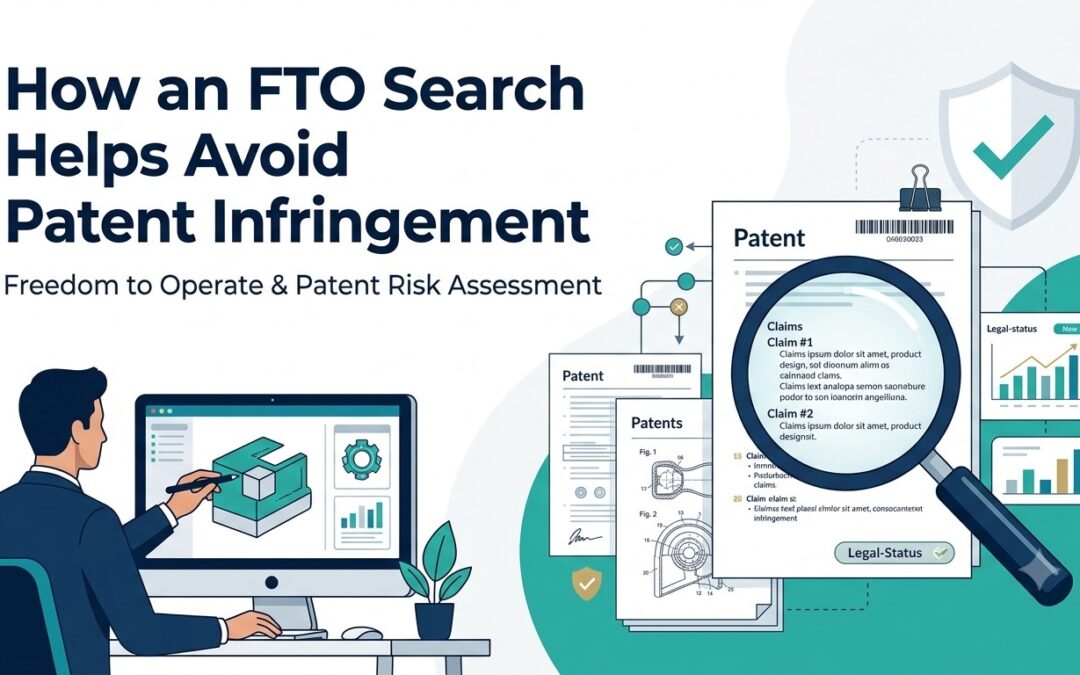
Launching a new product involves more than proving that the technology works. A business must also determine whether its product could infringe someone else’s patent rights. This is where a Freedom to Operate (FTO) search becomes valuable. An FTO search helps identify potentially relevant third-party patents before a product enters the market. It can therefore help businesses identify patent risks early and make informed commercialization decisions. However, an FTO search does not provide an absolute guarantee against infringement. Instead, it provides a structured assessment of potential patent risks within defined jurisdictions, technologies, and time periods.
What Is a Freedom to Operate Search?
A Freedom to Operate search is an investigation of existing patent rights that could potentially affect the commercialization of a particular product, process, or technology. The search generally focuses on enforceable or potentially enforceable patent rights in the jurisdictions where the business intends to operate. Unlike a patentability search, an FTO search does not primarily ask whether your invention is new. Instead, it asks whether your proposed activities could potentially fall within the scope of relevant third-party patent claims. Therefore, FTO and patentability searches serve different purposes.
Why Is an FTO Search Important Before Product Launch?
A product can be innovative and still create patent infringement risks. For example, a company may develop a new medical device that contains a component already covered by another company’s patent. The company’s own patent application would not automatically give it freedom to commercialize that product. Consequently, businesses should evaluate third-party patent rights before committing significant resources to manufacturing, marketing, or distribution. An early FTO assessment can help identify potentially relevant patents while product modifications remain practical.
How Does an FTO Search Identify Patent Risks?
An FTO search begins by understanding the product or process being assessed. The analysis may examine technical components, functions, methods, materials, software features, and other relevant elements. Researchers then identify patents and applications containing potentially relevant claims. The next step involves reviewing the claims, rather than relying solely on patent titles or abstracts. This distinction is critical because infringement generally depends on the scope and interpretation of relevant claims.
FTO Searches Focus on Patent Claims
A patent may describe hundreds of technical features. However, not every feature necessarily determines infringement. The claims define the legal boundaries of the patent rights. Therefore, an FTO analysis should identify claims that potentially cover the product, process, or activity being evaluated. The analyst should then examine whether the relevant patent remains enforceable in the target jurisdiction. This makes claim-level analysis a critical part of an FTO assessment.
Patent Legal Status Matters
Finding a technically relevant patent does not automatically mean that it creates a current commercialization risk. The patent’s legal status must also be examined. For example, a patent may have expired, been abandoned, or lapsed. A pending application may also require a different type of risk assessment from an enforceable granted patent. Furthermore, legal status can differ between jurisdictions. Therefore, an FTO analysis should evaluate relevant patent rights in the specific countries where commercialization is planned.
FTO Search and Patent Expiry
Patent rights are generally time-limited. Consequently, an older patent may no longer create the same risk as an active patent. However, businesses should not assume that an old patent is irrelevant. Patent families may contain related applications, continuation or divisional applications, or corresponding rights in different jurisdictions. Therefore, the complete patent family and relevant legal status should be reviewed.
How FTO Helps During Product Development
FTO analysis is not limited to products that are ready for launch. It can be performed during product development. Early analysis can identify potentially problematic patent claims while engineers can still modify the design. For example, a company may discover that a particular technical configuration overlaps with a third-party patent. The company could then explore alternative designs or technical approaches. This process is often called design-around strategy.
What Happens When an FTO Search Finds a Relevant Patent?
Finding a potentially relevant patent does not automatically mean that commercialization must stop. The next step is detailed claim analysis. Depending on the circumstances, the business may consider several options. It may modify the product, challenge the relevance or validity of the patent, seek a licence, wait for expiry, or obtain a more detailed legal opinion. The appropriate approach depends on the patent claims, legal status, jurisdiction, product design, and commercial circumstances.
FTO Search vs Patentability Search
Businesses frequently confuse these two searches.
| Patentability Search | FTO Search |
|---|---|
| Determines whether an invention may qualify for a patent | Assesses potential third-party patent risks |
| Focuses on novelty and inventive step | Focuses on relevant patent claims and rights |
| Primarily invention-focused | Product and commercialization-focused |
| Often examines prior art broadly | Focuses on relevant enforceable or potentially enforceable rights |
| Supports patent filing decisions | Supports commercialization decisions |
Therefore, a business may need both searches at different stages.
When Should You Conduct an FTO Search?
The ideal timing depends on the product and industry. However, an FTO assessment can be particularly useful before:
- commercial product launches;
- large-scale manufacturing;
- entering a new country;
- licensing technology;
- acquiring a technology business;
- investing heavily in product development; or
- launching a major product redesign.
Conducting the search early can provide more time to respond to identified risks.
Can an FTO Search Guarantee Freedom From Infringement?
No. Patent databases may contain incomplete or changing information. New applications can also remain unpublished for a period. Furthermore, patent interpretation involves legal questions that may require specialist analysis. An FTO search should therefore be understood as a risk assessment, not an absolute guarantee. A formal legal opinion may be appropriate when the commercial or litigation risk is significant.
How Businesses Can Reduce Patent Infringement Risk
An effective FTO process should begin with a clear definition of the product and intended commercial activities. Next, businesses should identify relevant jurisdictions and conduct comprehensive patent searches. The resulting patents should then undergo claim-level and legal-status analysis. Finally, potentially relevant patents should be prioritized according to their technical and commercial relevance. This approach converts large volumes of patent information into actionable IP risk intelligence.
FTO Search for Startups and Growing Businesses
Startups often focus heavily on product development and market entry. However, an unexpected patent dispute can disrupt those plans. An FTO search can help startups identify third-party patent risks before investing heavily in manufacturing or market expansion. It can also support investor discussions by demonstrating that the company has considered its IP risk exposure. For technology startups entering regulated or patent-intensive industries, this assessment can be particularly valuable.
Assess Patent Risk Before You Launch
A product launch can involve substantial investment in research, manufacturing, marketing, and distribution. Identifying potentially relevant third-party patents before commercialization can help businesses make better-informed decisions.
ORIGIIN IP Solutions LLP provides patent search and analytics services to help businesses assess patent landscapes, competitor portfolios, and potential IP risks.
👉 Explore ORIGIIN’s Patent Search & Analytics Services:
https://origiin.com/patent-search-and-analytics-services/
Conclusion
An FTO search helps businesses identify potentially relevant third-party patent rights before commercializing a product or technology. By reviewing patent claims, legal status, patent families, and relevant jurisdictions, businesses can better understand their potential exposure. Moreover, conducting an FTO assessment during product development can create opportunities for design changes before commercialization. Ultimately, FTO analysis should form part of a broader IP risk-management strategy. It does not eliminate patent risk. Instead, it helps businesses identify and evaluate that risk before it becomes a costly commercial problem.
Frequently Asked Questions
1. What is an FTO search?
An FTO search identifies potentially relevant third-party patent rights that could affect the commercialization of a product, process, or technology.
2. Does an FTO search prevent patent infringement?
An FTO search does not itself prevent infringement. It helps identify potential risks so businesses can evaluate appropriate responses.
3. When should an FTO search be conducted?
Businesses can conduct FTO searches during product development and before manufacturing, launching, licensing, or entering new markets.
4. Is an FTO search the same as a patentability search?
No. A patentability search assesses whether an invention may qualify for patent protection, while an FTO search assesses potential third-party patent risks.
5. Why are patent claims important in an FTO search?
Claims define the scope of patent protection. Therefore, claim-level analysis is essential when assessing potential infringement.
6. Does an expired patent create FTO risk?
An expired patent generally does not provide enforceable patent protection. However, the complete patent family and relevant jurisdiction should be reviewed before reaching a conclusion.
7. Can an FTO search guarantee that a product will not infringe?
No. An FTO search is a risk assessment and cannot guarantee the absence of infringement.
Disclaimer: This article provides general information about Freedom to Operate searches and patent infringement risks. It is not legal advice or a legal opinion. Patent rights and legal status can vary by jurisdiction and over time. Businesses should obtain appropriate professional legal advice before making significant commercialization decisions.