Expanding into international markets is an exciting milestone for any innovator or business. However, protecting your invention across multiple countries often raises an important question: Should you file a Patent Cooperation Treaty (PCT) application or file separate patent applications directly in each country?
There is no one-size-fits-all answer. The right approach depends on your business goals, target markets, budget, and commercialization plans. While both routes ultimately lead to patent protection in individual countries, they differ significantly in terms of process, flexibility, timelines, and strategic advantages. Understanding these differences can help businesses make informed decisions and avoid costly mistakes during international patent filing.
Understanding the Two Routes to International Patent Protection
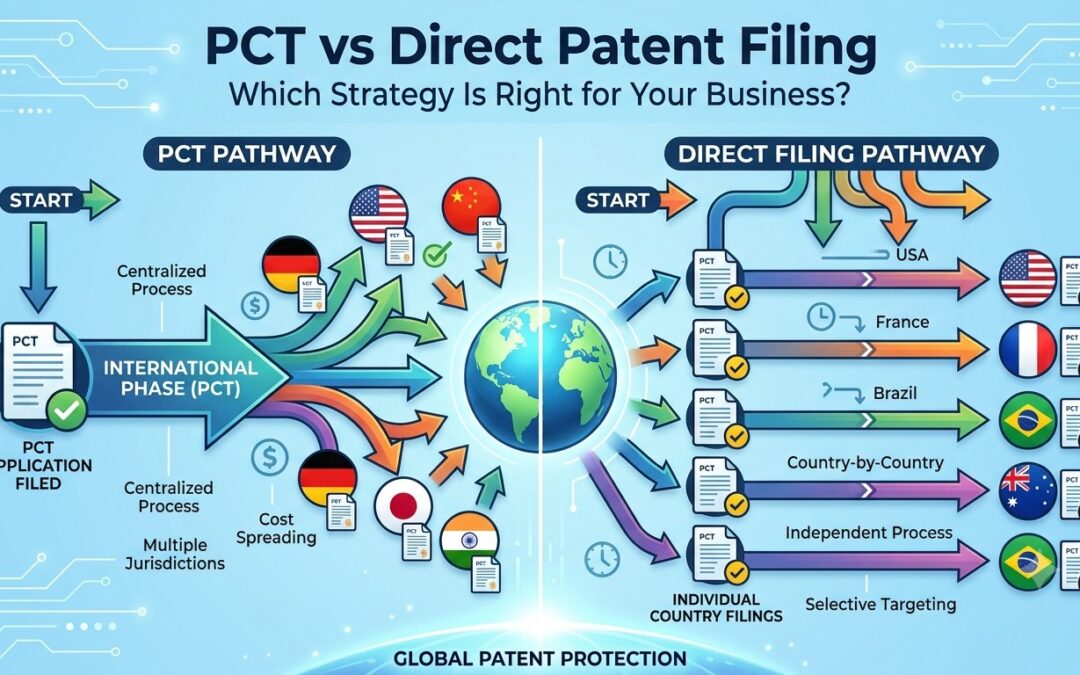
When inventors decide to seek patent protection beyond their home country, they generally have two options. The first is to file separate patent applications directly in each country where protection is required. The second is to file a single international application under the Patent Cooperation Treaty (PCT), which preserves the option of seeking patent protection in more than 150 participating countries. It is important to remember that the PCT does not grant an “international patent.” Instead, it simplifies the filing process by providing a unified initial procedure before applicants enter the national phase in their chosen countries. Direct filing, on the other hand, involves filing separate patent applications with each national or regional patent office from the outset.
How Does Direct Patent Filing Work?
Direct filing is the traditional route for obtaining patent protection outside your home country. After filing the first patent application, applicants can file corresponding applications in individual countries, generally within 12 months under the Paris Convention. Each application is examined independently according to the laws of the respective jurisdiction. For businesses targeting only a few countries, direct filing may be a practical and cost-effective option. However, managing multiple filings simultaneously requires careful coordination, country-specific documentation, translations, local patent attorneys, and payment of separate official fees.
How Does the PCT Route Work?
The Patent Cooperation Treaty provides applicants with a single international filing procedure. After filing a PCT application, applicants receive an International Search Report and Written Opinion, which offer an early assessment of the invention’s patentability. The application is then published internationally, after which applicants decide whether to enter the national phase in individual countries. Most countries require national phase entry within 30 or 31 months from the earliest priority date, giving applicants significantly more time to evaluate the commercial potential of their invention before committing to multiple national filings. This additional time often proves valuable for startups seeking funding, testing markets, or identifying suitable licensing opportunities.
PCT vs Direct Patent Filing: A Comparison
| Factor | PCT Filing | Direct Patent Filing |
|---|---|---|
| Initial Filing | One international application | Separate applications in each country |
| Number of Countries | Up to 150+ participating countries | Only selected countries |
| Filing Timeline | National phase generally at 30/31 months | Usually within 12 months under the Paris Convention |
| Initial Cost | Lower upfront international filing costs | Higher if filing in multiple countries immediately |
| Commercial Flexibility | More time to assess markets | Immediate commitment to selected jurisdictions |
| Patent Examination | International search followed by national examination | National examination begins directly |
| Suitable For | Businesses considering multiple countries | Businesses targeting a limited number of countries |
When Does Direct Patent Filing Make Sense?
Direct filing is often suitable when businesses already know exactly where they intend to commercialize their invention. For example, if a company plans to manufacture exclusively in India and sell only in India and the United States, filing directly in those two countries may be more efficient than pursuing the PCT route. Direct filing may also benefit applicants working under tight commercialization timelines or those with a clearly defined international strategy from the beginning. For inventions targeting only one or two jurisdictions, the administrative simplicity of direct filing can outweigh the broader flexibility offered by the PCT system.
When Is the PCT Route the Better Choice?
The PCT route becomes particularly valuable when businesses are still evaluating international opportunities. Many startups file a PCT application while seeking investment, negotiating licensing agreements, or assessing demand across different markets. The additional time provided by the PCT system allows businesses to delay significant country-specific expenses while preserving future filing options. This flexibility is especially useful for emerging companies with limited budgets but ambitious international growth plans.
Factors to Consider Before Choosing a Filing Strategy
Selecting between PCT and direct filing should never be based solely on cost. Businesses should consider several strategic factors, including their target markets, commercialization timeline, available budget, manufacturing plans, licensing objectives, investor expectations, and long-term intellectual property strategy. For example, a startup planning global expansion may benefit from the flexibility of the PCT route, whereas a company entering only two countries may find direct filing more practical. Every invention has different commercial objectives, and the filing strategy should support those objectives rather than simply following a standard approach.
Common Mistakes Businesses Make
One common misconception is that filing a PCT application automatically results in worldwide patent protection. In reality, applicants must still enter the national phase and satisfy the legal requirements of each country where protection is sought. Another frequent mistake is delaying strategic planning until shortly before the national phase deadline. By then, businesses may face budget constraints, translation challenges, or insufficient time to evaluate target markets. Some applicants also underestimate the importance of a well-drafted patent specification. Since amendments after filing are often restricted, the quality of the initial application can significantly influence future patent protection.
Planning an International Patent Filing Strategy?
Choosing between PCT and direct filing is only one part of the process. A strong patent application, well-defined filing strategy, and timely national phase planning are equally important for securing meaningful international protection. Whether you are preparing your first international filing or expanding an existing patent portfolio, ORIGIIN’s patent professionals can help you develop a strategy aligned with your commercial goals.
👉 Explore ORIGIIN’s PCT National Phase Entry Services:
https://origiin.com/pct-national-phase-entry-india/
Why Professional Patent Drafting Is Critical
Regardless of the filing route, every international patent strategy begins with a strong patent specification. A poorly drafted application can limit the scope of protection, reduce flexibility during prosecution, and create challenges during national phase examination. Professional patent drafting ensures that the invention is described comprehensively, supported by robust claims, and structured to accommodate international filing requirements. Investing in quality drafting early often proves far more valuable than attempting to correct deficiencies later.
Conclusion
Both PCT and direct patent filing offer valuable pathways to international patent protection. The best choice depends on your business objectives, target markets, financial resources, and commercialization plans. If your business is exploring multiple international markets or requires additional time before making country-specific decisions, the PCT route offers valuable flexibility. Conversely, if your target jurisdictions are already defined and relatively limited, direct filing may provide a more straightforward path. The key is to choose a filing strategy that supports your long-term innovation and business goals rather than simply following the most familiar option.
Protect Your Innovation with the Right International Patent Strategy
International patent protection is a significant investment, and choosing the right filing route can have a lasting impact on your business. From patent drafting and PCT filings to national phase entry and prosecution, strategic guidance can help you maximise the value of your intellectual property. ORIGIIN assists innovators, startups, universities, and businesses with end-to-end patent filing and prosecution services tailored to domestic and international markets.
👉 Speak with ORIGIIN’s patent experts to develop an international patent strategy that aligns with your business goals.
https://origiin.com/contact-us/
Frequently Asked Questions
1. What is the difference between PCT and direct patent filing?
A PCT application provides a unified international filing procedure and delays country-specific filings, while direct filing requires separate patent applications to be filed in each selected country from the outset.
2. Does a PCT application grant an international patent?
No. The PCT simplifies the filing process but does not grant a worldwide patent. Patent rights are granted only after successful examination by national or regional patent offices.
3. When should a business choose direct patent filing?
Direct filing is often suitable when protection is required in only one or a few countries and the target markets have already been identified.
4. Why do startups often choose the PCT route?
The PCT route provides additional time to secure funding, evaluate commercial opportunities, identify target markets, and decide where to pursue patent protection.
5. Is patent drafting important for international filings?
Yes. A well-drafted patent specification forms the foundation of both PCT and direct filings. Strong drafting improves examination outcomes and supports broader, more enforceable patent protection.